

Barefoot Shoes vs. Custom Orthotics for Flat Feet & Plantar Fasciitis: Train or Protect?
3 mins

Barefoot shoes — also known as minimalist shoes (Barefoot Shoes / Minimalist Shoes) — have been quietly building a devoted following across Hong Kong in recent years. Championing zero-drop construction and a wide toe box, the barefoot shoe philosophy is built around a single idea: free your feet from the constraints of conventional footwear and let them move the way nature intended.
For many people in Hong Kong living with plantar fasciitis, flat feet or high arches, this naturally raises a question that comes up again and again in the clinic: "If barefoot shoes can train the muscles of my feet, do I still need custom orthotics (Custom Orthotics) made specifically for me?"
The honest answer is that this was never an either-or decision to begin with. As registered podiatrists (Podiatrist) practising in Hong Kong, one of the things we emphasise most consistently in the clinic is this: barefoot shoes and custom orthotics are not competitors — they are complements. One trains. The other protects. Together, they are more powerful than either could ever be alone.
This article takes a thorough look at what genuinely separates the two, where each one is commonly misused, and how to build a foot health strategy around your own lifestyle and foot condition — one that works specifically for you.
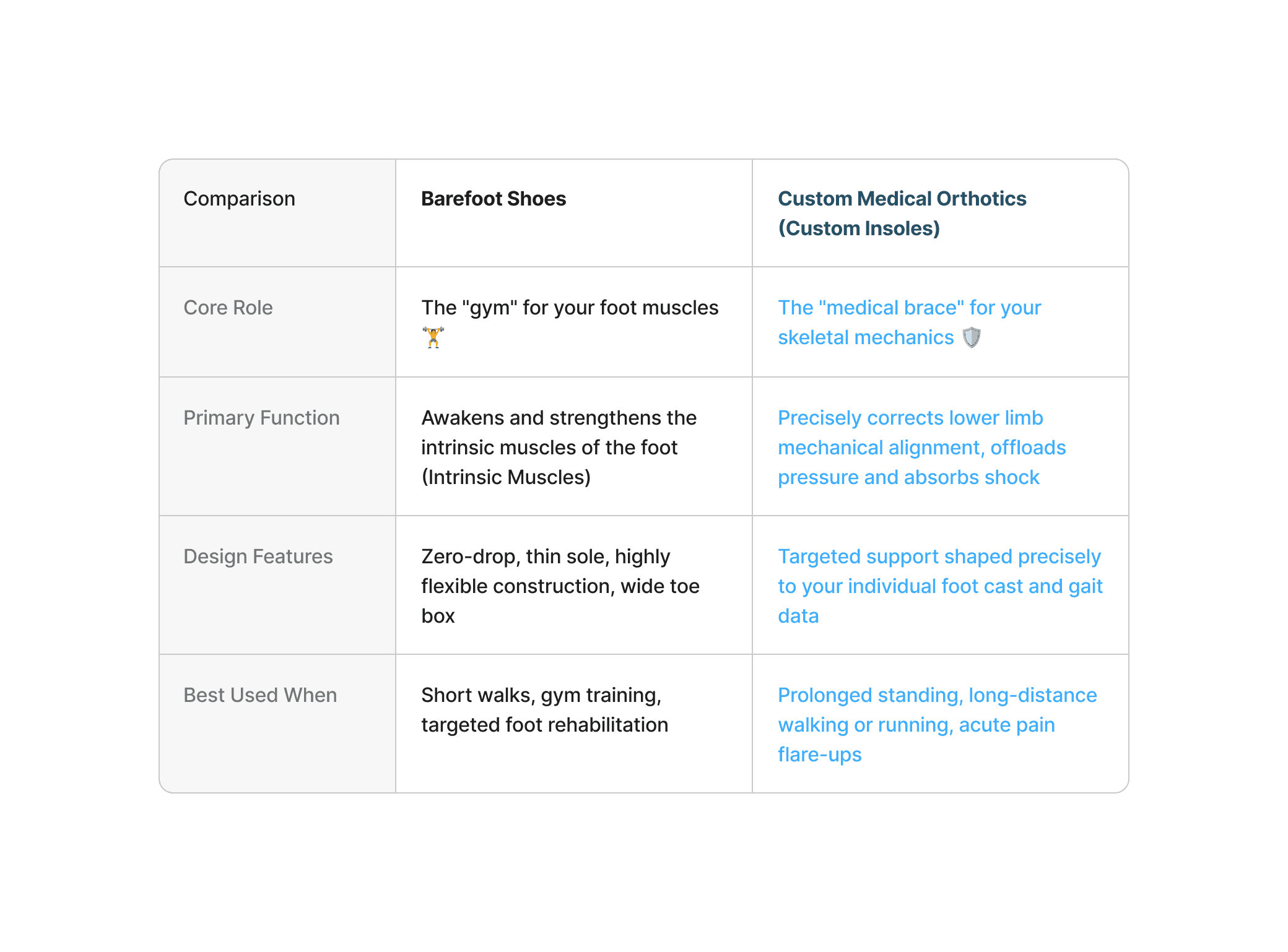
The Core Difference: Barefoot Shoes vs. Custom Orthotics
Before choosing the right tool, it helps to understand what each one is actually designed to do — and where each one sits within the framework of lower limb biomechanics (Biomechanics).
The Blind Spot of Barefoot Shoes: Why Timing Matters More Than You Think
Barefoot shoes are built around the idea of returning to nature — but for anyone walking the streets of Hong Kong, that means returning to nature on some of the hardest, most unforgiving surfaces your feet will ever encounter. Concrete. Tarmac. Stone. All day long.
When your foot structure is already significantly compromised — moderate to severe flat feet, a collapsed arch — or when you are in the acute inflammatory phase of plantar fasciitis or Achilles tendinopathy (跟腱炎), your fascial tissue is already operating under extreme tension and vulnerability. The last thing it needs is more unmediated ground contact force.
Switching to a completely unsupported, zero-cushion barefoot shoe at this stage and walking for hours on hard ground is, in clinical terms, the equivalent of pouring salt directly into an open wound. The fascial tissue that is already under excessive load is now asked to absorb every impact without any structural support whatsoever — the result is not recovery. It is reinjury, and often significantly worse reinjury than what brought the patient in to begin with.
What Custom Orthotics Actually Do: Precision Offloading and Biomechanical Correction
Custom orthotics work differently — and the difference matters. Think of a well-prescribed pair of custom orthotics as a precision protective shield for your feet.
When lower limb biomechanics are compromised — excessive overpronation (Overpronation) being one of the most common presentations we see — orthotics work by realigning the skeletal architecture of the foot from the ground up, redistributing pressure away from the high-load zones (Offloading) with a level of precision that no off-the-shelf insole can replicate. Through carefully engineered arch support and shock absorption, the orthotic creates a protected environment in which injured soft tissue can genuinely recover — so that even during long days on your feet, standing at work or covering distance on a hike, you are not continuously compounding the damage already done.
The Perfect Complement: The Golden Combination Strategy
Lasting foot health is not about choosing between protection and training. It is about knowing when each one serves you best — and having the confidence to use both.
1. High-intensity activity / prolonged standing / active pain ➡️ 【Orthotics + Supportive Footwear】
When to use this: Long working days on your feet, hiking, long-distance running, or any time you are experiencing significant pain or discomfort.
What it achieves: Structural biomechanical support and shock absorption — protecting the fascia, joints and soft tissue from cumulative fatigue and further loading.
2. Low-intensity activity / targeted training / leisure time ➡️ 【Barefoot Shoes】
When to use this: Indoor strength training (squats, deadlifts), short recreational walks, or any activity on natural soft surfaces such as grass or sand.
What it achieves: Natural toe splay, stimulation of plantar proprioception and sensory feedback, and targeted conditioning of the intrinsic foot muscles.
The Bottom Line: There Is No Perfect Shoe — Only the Right Strategy for Where You Are Right Now
No single shoe and no single orthotic can solve every foot problem. What makes the difference is understanding your own foot type, your gait pattern, and the stage of recovery or conditioning your feet are currently in.
If you are dealing with persistent pain underfoot, feet that tire quickly on even moderate walks, or simply aren't sure whether your feet need strengthening or protecting right now — this is exactly the kind of question a registered podiatrist is trained to answer. A detailed lower limb biomechanical assessment (Biomechanical Assessment) and dynamic gait scan are the only reliable way to identify the root cause of what you are experiencing — and to build a management plan that is designed specifically around you, not around a general recommendation.
💡 Want to learn more about foot health — or book a lower limb biomechanical assessment?
Get in touch with our podiatry team. We're here to help your feet take every step forward with confidence.